Poisoned at the Source: How Attackers Weaponize Software Updates Against the Users Who Trust Them
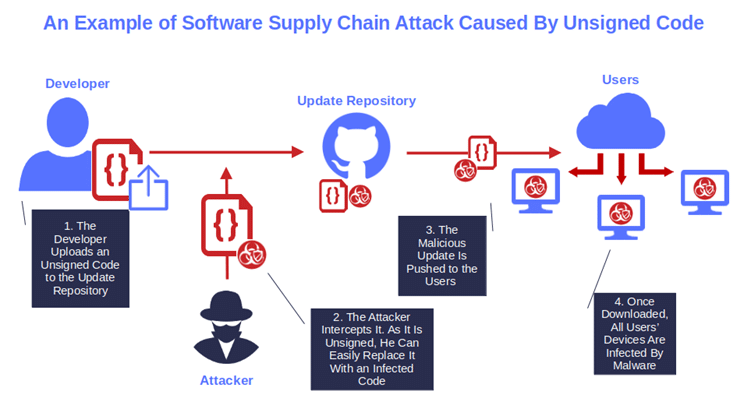
Photo: software update security supply chain attack developer code, via codesigningstore.com
The security advice has been repeated so often it has become reflex: keep your software updated. Patches close vulnerabilities. Updates protect you. Install them promptly.
That advice remains sound. But a sophisticated category of attack has emerged that exploits the very trust users place in the update process itself. In a supply-chain attack targeting software distribution, the threat does not arrive through a phishing link or a brute-forced password. It arrives disguised as the patch you were told to install.
How a Trusted Channel Becomes a Threat Vector
To understand why these attacks are so dangerous, it helps to understand what makes software updates trustworthy in the first place. When a developer releases a patch, the update typically travels through a defined pipeline: source code is compiled into an executable, signed with a cryptographic certificate that authenticates the developer's identity, hosted on a distribution server, and then delivered to end users—either automatically or on demand.
At each stage in that pipeline, there is a potential point of compromise. Attackers who gain access to a developer's build environment can insert malicious code before the software is compiled, meaning the resulting executable is both genuinely signed and genuinely malicious. Those who compromise a distribution server can swap out a legitimate update file for a tampered one. Those who intercept the delivery mechanism—particularly relevant in enterprise environments that rely on centralized update servers—can redirect clients to receive corrupted payloads.
In every scenario, the victim's machine receives what appears to be a legitimate, signed update from a trusted vendor. Traditional security tooling, which relies heavily on signature verification, may raise no alarm whatsoever.
Landmark Cases That Changed the Security Landscape
SolarWinds Orion (2020) remains the most consequential supply-chain attack in recent memory. Threat actors—subsequently attributed by U.S. intelligence agencies to a Russian state-sponsored group—gained access to SolarWinds' software build environment and inserted a backdoor into routine updates for the company's Orion IT monitoring platform. The malicious updates were cryptographically signed by SolarWinds itself and distributed to approximately 18,000 customers, including agencies of the U.S. federal government, Fortune 500 companies, and critical infrastructure operators. The intrusion went undetected for months. The damage—in terms of compromised networks, stolen data, and national security implications—is still being assessed years later.
CCleaner (2017) demonstrated that consumer-facing software is equally vulnerable. Attackers compromised the build environment of Avast-owned CCleaner, a widely used system optimization tool, and pushed a backdoored version to approximately 2.27 million users through the application's official update mechanism. The malicious version passed Avast's own code-signing process undetected. A second-stage payload was subsequently delivered to a more targeted subset of high-value corporate victims.
3CX (2023) illustrated how supply-chain compromises can chain together. The desktop application for 3CX, a widely deployed business communications platform, was trojanized through an update. Investigation revealed that the 3CX software itself had been compromised partly because an employee's machine had previously been infected through a separate supply-chain attack on financial software—one poisoned update enabling the next.
These are not isolated incidents. The 2021 Kaseya VSA attack, the ASUS Live Update compromise in 2019, and the NotPetya incident in 2017—which spread globally via a corrupted update to Ukrainian accounting software—collectively paint a picture of a threat that has matured into a preferred technique for sophisticated adversaries.
The Technical Mechanics in Plain Terms
For readers without a deep technical background, the core concept can be summarized as follows: software developers trust their own build systems, and end users trust software from developers they recognize. A supply-chain attacker exploits both layers of trust simultaneously.
Cryptographic code signing—the technology that lets your operating system verify that an update genuinely came from, say, Microsoft or Adobe—authenticates the origin of software but cannot verify the integrity of the development environment that produced it. If an attacker has already compromised the environment where code is compiled and signed, the resulting malware carries a legitimate signature.
This is fundamentally different from a scenario where an attacker merely claims to be a legitimate vendor. The software is from the legitimate vendor—it has simply been altered before it left their hands.
What Individuals Can Do
The honest assessment is that no individual user can fully defend against a sophisticated supply-chain attack targeting a major software vendor. If the update is signed, comes from the official server, and passes all automated checks, a non-technical user has limited means to detect the compromise independently.
However, several practices meaningfully reduce risk.
Delay non-critical updates briefly. Security professionals sometimes refer to this as "patch Tuesday plus a few days." Waiting 48 to 72 hours after a non-emergency update is released allows time for the security community to flag anomalies in the new version before you install it. This is not a reason to defer critical security patches indefinitely—the calculus changes when a known vulnerability is being actively exploited—but for routine application updates, a short delay costs little and provides a modest buffer.
Monitor security news sources before major updates. A quick search for the software name and version number before installing can surface early reports of problems. Outlets including Bleeping Computer, Krebs on Security, and the SANS Internet Storm Center frequently post early warnings when something is wrong with a widely distributed update.
Use endpoint security software from a reputable vendor. Modern endpoint detection and response tools can identify anomalous behavior from a process, even if its signature is valid. An update that begins beaconing to an unusual external server or attempting to access credential stores will trigger behavioral alerts that signature-based tools would miss.
Verify file hashes when they are published. Many developers publish SHA-256 checksums alongside their installers. Comparing the hash of the downloaded file against the published value confirms the file was not tampered with in transit. This does not protect against a compromise at the source, but it does catch man-in-the-middle interceptions and corrupted downloads.
Maintain offline or isolated backups. Supply-chain attacks often deploy ransomware or destructive payloads as a second stage. Verified, air-gapped backups limit the damage a successful compromise can inflict.
For Small Businesses
Organizations operating centralized patch management systems—common in small and mid-sized businesses—should ensure those systems are themselves kept rigorously up to date and access-controlled. The Kaseya attack exploited a managed service provider's update infrastructure to reach hundreds of downstream businesses simultaneously. A compromised patch server is a force multiplier for attackers.
Small businesses should also consider implementing application allowlisting, which restricts the execution of software to a pre-approved list, and network segmentation, which limits the lateral movement an attacker can achieve even after a successful compromise.
Trust Is a Security Architecture
The deeper lesson of supply-chain attacks is that trust, in the security context, is not a feeling—it is an architecture that must be designed, verified, and continuously monitored. The update mechanism that protects your system most of the time is precisely the mechanism attackers most want to subvert, because its trustworthiness is what makes it so powerful a delivery vehicle.
Keep updating your software. The alternative—leaving known vulnerabilities unpatched—is far more dangerous than the residual risk of supply-chain compromise. But update with awareness: verify when you can, monitor security channels, and understand that in the current threat landscape, even the most routine-looking patch deserves a moment of scrutiny.