The Takedown Files: How the FBI and Global Partners Dismantled the Dark Web's Most Notorious Marketplaces
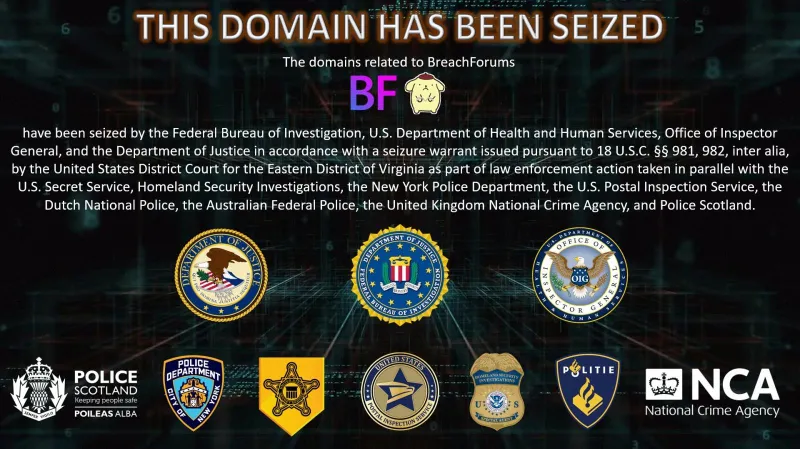
Photo: FBI cybercrime investigation dark web server seizure law enforcement, via www.bleepstatic.com
For a period stretching roughly from 2011 to the early 2020s, a succession of underground digital marketplaces operated with a confidence that bordered on arrogance. Their administrators believed that Tor's anonymizing architecture, cryptocurrency's pseudonymity, and the sheer complexity of international jurisdiction had rendered them untouchable. Federal agents, prosecutors, and their counterparts across Europe and Asia spent years proving otherwise.
The stories of Silk Road, AlphaBay, and Hydra Market are not simply crime narratives. They are case studies in how criminal organizations build, sustain, and ultimately destroy themselves — and in how law enforcement has evolved to meet a category of threat that did not exist a generation ago.
The Architecture of Anonymity — and Its Limits
To understand these takedowns, it is first necessary to understand what the dark web actually is. The term refers to websites and services accessible only through anonymizing software, most commonly the Tor network, which routes internet traffic through a series of encrypted relays to obscure a user's origin. These sites use .onion addresses rather than conventional domain names and do not appear in standard search engine results.
The Tor network itself was originally developed by the US Naval Research Laboratory and remains a legitimate privacy tool used by journalists, dissidents, and security researchers worldwide. Its misuse by criminal enterprises does not diminish its lawful applications — a distinction that gets lost in sensationalized media coverage.
What made dark web marketplaces attractive to criminals was the combination of Tor's anonymity with cryptocurrency payments, which allowed transactions to occur without the direct involvement of traditional financial institutions. The assumption was that this combination created an impenetrable shield. It did not.
Silk Road: The Original Sin
Silk Road, launched in 2011 by Ross Ulbricht under the pseudonym Dread Pirate Roberts, is widely regarded as the first large-scale dark web marketplace. At its peak, it offered tens of thousands of listings for controlled substances and generated hundreds of millions of dollars in Bitcoin transactions. Ulbricht cultivated an ideological veneer around the operation, framing it as a libertarian experiment in free markets beyond state control.
The investigation that brought Silk Road down was led by the FBI, IRS Criminal Investigation, and the Drug Enforcement Administration, among other agencies. The decisive break did not come from cracking Tor. It came from a 2013 forum post in which Ulbricht had inadvertently used his personal Gmail address while promoting Silk Road in its earliest days — a single operational security failure that allowed investigators to connect his real identity to the alias.
Ulbricht was arrested in a San Francisco public library in October 2013. He was subsequently convicted on multiple federal charges, including drug trafficking and money laundering, and sentenced to life in prison without the possibility of parole. The case established a foundational principle that would recur in every subsequent major takedown: sophisticated technical infrastructure cannot compensate for human error.
AlphaBay: A Larger Stage, a Faster Fall
AlphaBay emerged after Silk Road's closure and grew to dwarf its predecessor. By 2017, it was processing an estimated $800,000 in daily transactions and offered listings that extended well beyond drugs into weapons, counterfeit documents, and malware. Its administrator, Alexandre Cazes, a Canadian national operating primarily from Thailand, appeared to have learned from Ulbricht's mistakes.
He had not. The investigation, a joint operation involving the FBI, DEA, Europol, and Thai authorities, identified Cazes through a password reset email that AlphaBay sent to users — an email that contained a personal Hotmail address registered in his own name. That address led investigators to his financial accounts, real estate holdings, and physical location.
Thai authorities arrested Cazes at his home in Bangkok in July 2017. Days later, he was found dead in his cell in what authorities ruled a suicide. The simultaneous seizure of AlphaBay's servers allowed investigators to harvest a substantial volume of transaction data, leading to further arrests of vendors and buyers across multiple countries. The operation was coordinated with the near-simultaneous takedown of Hansa Market by Dutch police — a deliberate tactical maneuver designed to prevent displaced AlphaBay users from migrating to a safe alternative.
Hydra: The Geopolitical Dimension
Hydra Market represented a distinct evolution in the dark web ecosystem. Operating primarily in Russian-language markets, it was the dominant marketplace for drug sales across Russia and Eastern Europe for years, generating an estimated $1.35 billion in revenue in 2021 alone. It also offered money-laundering services, making it a node in broader financial crime networks.
Its takedown in April 2022 was a joint operation between the US Department of Justice, the FBI, the DEA, and German federal authorities, who physically seized Hydra's server infrastructure located in Germany. The Treasury Department simultaneously sanctioned Hydra and several associated cryptocurrency exchange services, targeting the financial infrastructure that sustained the marketplace.
The Hydra operation illustrated the growing importance of financial intelligence in dark web investigations. Blockchain analytics firms, working alongside federal agencies, traced cryptocurrency flows across wallets and exchanges to identify both the marketplace's operators and some of its most prolific vendors. The pseudonymity of cryptocurrency, it turns out, is considerably more fragile than its early proponents claimed — particularly when investigators can analyze the public ledger with sophisticated pattern-recognition tools.
What Law Enforcement Learned
Across these three landmark cases, several consistent themes emerge. Operational security failures at the human level — a carelessly used email address, a real name attached to a financial account, a forum post from years earlier — proved more consequential than any technical vulnerability in Tor or cryptocurrency protocols themselves.
International cooperation has become indispensable. No single agency possesses the jurisdiction, resources, or intelligence access to dismantle a global criminal marketplace alone. The partnerships between US federal agencies, Europol, and national law enforcement bodies in Germany, the Netherlands, Thailand, and elsewhere reflect a deliberate strategic investment in multilateral coordination.
Finally, these cases reveal the inherent fragility of criminal enterprises built on trust among anonymous parties. Dark web marketplaces are, at their core, reputation systems — and once law enforcement penetrates them, the trust that holds them together collapses rapidly.
The dark web remains active. New marketplaces emerge to replace those that are dismantled. But the record of Silk Road, AlphaBay, and Hydra makes clear that the promise of perfect anonymity was always more myth than reality — and that the gap between criminal ambition and sound operational practice has, so far, consistently favored the investigators.